

Clinical Results
Clinical Results
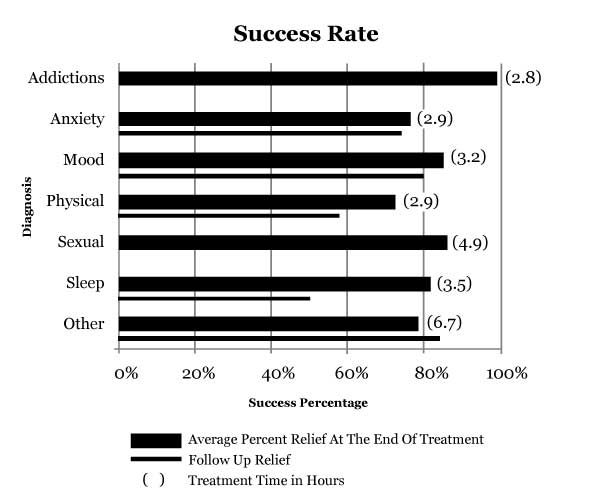
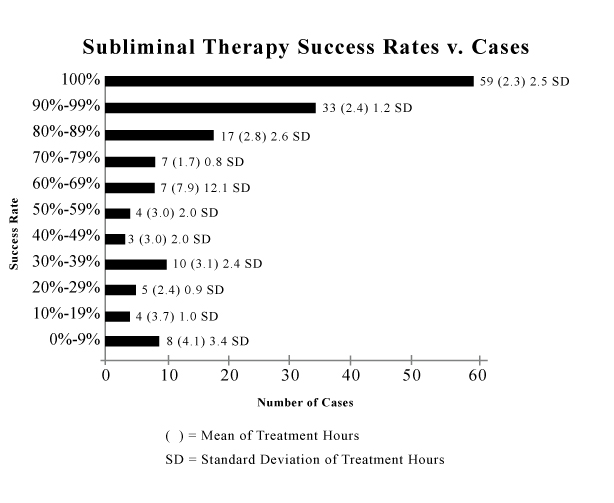
Dr. Edwin Yager has been formally researching the effectiveness of Subliminal Therapy since 2008. Since data collection began, an average 83% of patients reported improvement from their problems within three to six treatments. The tables below are added for a closer look at the research and if even more details are desired, they will be made available upon request.
Subjects:
The subjects of this study were all patients in Dr. Yager’s private practice. All 97 patients were adults with a mean age of 38 years, most of whom presented more than one problem. Forty-two patients were male, 55 were female. Of the 202 problems reported here, 88 were presented by males and 114 were presented by females. Seventeen patients were excluded from the study because of incomplete treatment.
Data Collection:
Patients were asked to complete a brief questionnaire at the initial session, again at the conclusion of treatment and (currently in execution) as a follow up. The form used was a one-page inventory of the effects the presenting problem was having on the patient’s life. Fifteen questions were asked and the patient was requested to indicate the degree of effect in each area by marking on a continuum representing “Not at all” to “Severe.” In the event more than one problem was presented, a separate form was used for each problem.
Data Processing:
The data was quantified by assuming the continuum of each question to represent 0-to-10, recording the value marked thereon, and averaging the scores. The averaged before-and-after scores were then evaluated using Percent Relief and the Effect Size computation of Cohen’s d and r.
Data presented in the following graphs and tables are derived from the inventories described above. Summaries of the data are presented in the tables and in the graphs that follow.
Success Rates – All Cases Combined
All Cases
Post-Treatment
Follow Up
> 3 months
Subjective Relief
78%
72%
n
202
47
Mean of Subjective Relief
78
71.6
Standard Deviation
31.2
38.9
Cohen’s d
3.54
2.6
Effect Size r
0.87
0.79
Average Treatment Time
3.5 hours
Table of the Success Rates of Subliminal Therapy
Diagnosis
Total n =
n
202
Percent
Improvement
Number of 100% Improvement
Average Treatment Hours
Addictions
11
1.4
99.6
9
2.1
Chemical
99.8
8
1.9
Other
2
87.0
1
3.5
Anxiety
73
35
75.9
27
2.9
General Anxiety D
24
72.5
6
4
Obsessive Compulsive D
18
76.4
5
Panic D
14
80.0
2.4
Phobic D
16
81.4
2.5
100
3
Mood D
36
21.1
85.2
15
Anger
84.1
Depression
83.7
Guilt
94
1.8
Grief
50
1.5
Jealousy
68
Shame
92
12
Physical
72.1
Pain
73.9
21
71.2
7
3.4
Sexual D
20
86
5.4
Addiction
85
2.3
Dyspareunia
Excess masturbation
Impotence
Pleasure barrier
Vaginismus
4.5
Sleep D
10
81.5
2.8
29
31
73.4
7.1
Follow up Data on the Preliminary Research:
Where possible, follow up inventories were obtained to determine the duration of the benefits shown in the data above. As of February 2012, 48 Follow up inventories have been received and 33 of them were from cases having a post-treatment success rates greater than 80%. Three additional cases had success but at less than 80% (Total of 64% of Follow up inventories). At Follow up, 3-to-47 months post-treatment, 11 of the 48 cases reported deterioration of their condition, with the remaining 37 cases having either maintained or improved their condition.
Conclusion:
Subliminal Therapy success rates are stable over time in 77% of the cases reported.