Clinical Hypnosis
Hypnosis has gotten a lot of bad press. In uninformed circles it is viewed with suspicion, as the work of charlatans, or even as sinful. This is both unfortunate and actually surprising since its use is endorsed by established religions, including the Catholic Church and the Jewish Faith, not to mention the American Medical Association, the American Psychological Association and the American Dental Association. The membership of the American Society of Clinical Hypnosis is made up of professionals from all recognized disciplines in the health and behavioral sciences, and the Society for Clinical and Experimental Hypnosis is international in nature. It's hard to imagine stronger endorsement.
What it is
We use the word “trance” to describe the state of mind that is commonly understood as being “hypnosis.” It is that state of physical and mental relaxation, coupled with unusual physical and mental abilities, that has been of such great value to so many. Actually, trance is but one of many hypnotic phenomena, and can be learned by any mentally competent person.
Hypnosis is, above all, a natural experience. It is an experience we all have many, many times in life without identifying it as hypnosis. We spontaneously slip into a hypnotic trance any time we are intensely emotional about something, such as when frightened, or angry, or grieving. Other examples include being in a movie, when the rest of the world ceases to exist, and include certain exercises of breathing to relieve stress. We also experience hypnosis when we are in the presence of authority – whatever we consider that authority to be. Perhaps the authority is a physician, teacher or (especially) mother. In such situations, we are more open to suggestions that may be stated by someone, inferred or imagined.
We can also experience trance on purpose, for some particular reason. We can do this when guided by another person, or when guided by ourselves, which we would call “self-hypnosis.”
Hypnosis is a state of mind that opens doors not normally open. In trance we can demonstrate strengths, both physical and mental, that are not available to us normally. We can change the way we “spontaneously” behave and we can influence the way we feel, and the way our bodies function. More importantly, for clinical purposes, we can think more clearly and we can remember things far more clearly and accurately.
What it is not
Hypnosis is not a state of unconsciousness. It is not a state in which control is given to someone else. It is true that we can be tricked while in trance, but then we can be tricked without trance as well. Indeed, responsibly used, hypnosis is a way of gaining control, not of losing it.
Because it is such a natural phenomenon, one of the most common reactions expressed by those experiencing hypnosis for the first time is to honestly question that they experienced hypnosis at all. We are led by misinformation to expect something different, something un-natural, and when that doesn't happen we may question that anything happened at all. Yet, when the changes that do occur, and there are a number of them, are pointed out to us while in trance, we can recognize its value.
Trance work
I teach self-hypnosis to all of my patients. That is, I teach them how to go into trance whenever they wish. As mentioned, trance is just one aspect of hypnosis, and is the state many refer to as being “hypnosis.” At least in the clinical setting, trance is a state that is easily experienced and easily learned. If there is fear, or concern about it in any respect, the fear can get in the way, and so it is important to be adequately reassured of its safety in advance. Once trance is experienced, all concerns about it cease to exist.
The most commonly recognized characteristic of hypnosis is that we are more suggestible than normal. As used here, “suggestible” refers to the ability to absorb and make a part of our experience some idea or concept, perhaps integrating it even without being consciously aware that we are doing so. In the clinical setting we may use suggestions directly for some purpose, or we may use other abilities that are afforded by the state to gain understanding of the causes of problems. That is, to “uncover” the influence that is causing the problem being addressed. Once the cause is understood, the door is open to change the consequence of the event that caused the problem. This is another way to use hypnosis and it is the most effective way in many cases.
Conditioning
We are conditioned by our experiences. We believe what we were taught to believe. We hold the values we learned early in life. We may be limited in some way only by believing we are limited. The blessing is that if we were conditioned one way, and if we know how to do so, we can change that conditioning. Hypnosis provides the means to change conditioning.
Hypnotic phenomena
In trance, we can increase or decrease the intensity of an emotion, or of our senses. We may focus our attention on something, or away from something, simply not being aware of it. We can increase muscle tension, as would happen if we were terrified, or we can totally relax. We can separate from emotional influence, or increase or decrease physical strength. We can remember events that are not available to us in the normal, waking state.
The trance state also permits the use of unconscious intelligence. The idea of being able to “think” unconsciously may be unusual, but we all do it. We may solve a problem while asleep, or drive a car in heavy traffic without consciously focusing on every step we take. In trance, we can use this intelligence to solve problems and to make desired changes.
Areas of Application
Each of the following areas of applications of treatment by hypnosis may involve direct suggestions, or may involve using hypnosis to uncover and correct influences from the past that are causing the present problems.
Relieving emotional distress
Whether depressed, anxious, or experiencing another unpleasant state of mind, we have likely become obsessed with our experience and may have difficulty relating to any other reality. In such a situation, experiencing the trance state will likely provide immediate relief and can set the stage for further work.
In some instances patients may respond to “symptomatic” suggestions, making further treatment unnecessary. Frequently, however, even in those instances where relief is immediate, total and dramatic, the symptoms are apt to return. In such instances long-term relief will likely require identification and resolution of causal influences.
Resolving the influence of prior trauma
Conditioned responses resulting from trauma may persist for a lifetime. Phobias, tics, stuttering, compulsions, obsessions, sexual dysfunction and various illnesses are all examples. It is as though a lesson is learned in an initial, sensitizing situation that was clearly appropriate for that situation, and yet the lesson continues to be controlling in spite of rational recognition of its current inappropriateness. It seems also true that the very traumatic nature of the initial experience may result in its memory being repressed, thereby making resolution difficult.
The concept of “resolving” influences from past experience is fundamental to analytic psychotherapy. Accomplishment first involves the identification of causal influence, beginning with the initial sensitizing event and including subsequent contributing events. It is here that hypnosis is of such great value. Identification is followed by objective evaluation of these influences and events from the perspective of present, more mature, knowledge and understanding, thereby achieving re-conditioning. The trance state can dramatically facilitate this process as well.
Behavior modification
Behavior resulting from conditioned response can be altered in a number of ways, using various techniques. The hypnotic trance can aid each of these techniques. Indeed, the trance state can facilitate each to a degree that is often surprising. The additional use of hypnosis to gain knowledge and understanding of the initial, sensitizing event, thereby permitting re-evaluation of its elements from the perspective of present, more mature knowledge, may prevail in the most difficult situations.
Altering physical responses
The link between emotion and physical response to emotion has been well established. For example, there is an impressive list of physical changes that take place in response to anger. They include changes in blood chemistry, heart and respiration rate, brain function and the pattern of blood flow in the body. A similar list applies to the emotion of fear, and other lists apply to other emotions. All this being true, it follows that we can influence physical functions by controlling emotions, a feat that is facilitated by hypnosis.
We know, for example, that stress can cause illness. It follows that relieving stress will facilitate healing, and hypnotic techniques provide by far the most efficient and effective way to relieve stress.
The correlations frequently observed between emotional state and physical disorders such as asthma and tension headaches, situational reactions such as anxiety, and many other disorders are common examples of the influence of unconscious intelligence that is misguided by unfortunate experience.
In response to hypnotic suggestions, such medical wonders as anesthesia, limiting blood loss in surgery, cardio-conversion, moderated pain in childbirth, altered physiological response to medications and a great many others are routinely reported by clinicians who employ hypnosis in their practice.
Introducing Subliminal Therapy
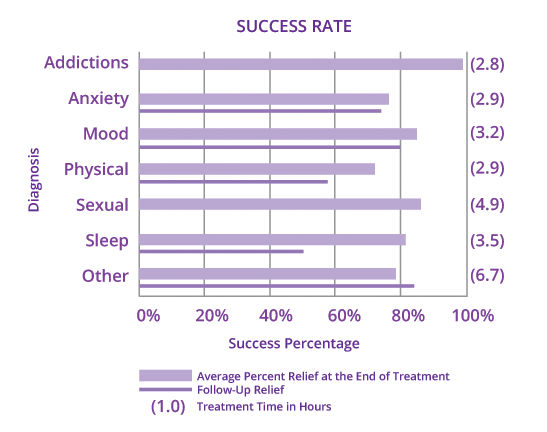
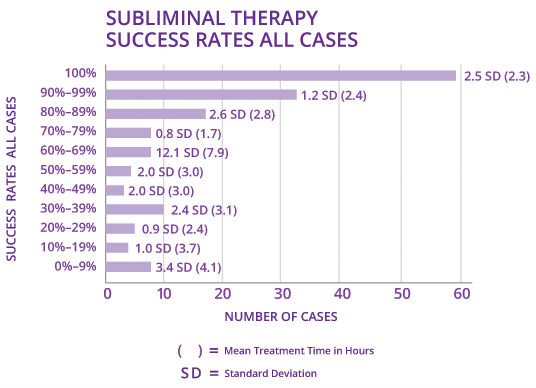
Basically a hypnotic technique that does not require a trance state for its use, Subliminal Therapy is the most time-efficient way of accomplishing desired change that I know. It is a technique I devised in 1974, has been used successfully with patients many thousands of times, and have taught in my hypnosis courses, since then.
In employing the principles of Subliminal Therapy, unconscious abilities are accessed and used for therapeutic purpose.
In our culture, we are taught to be in control, to get the information and act upon it. Yet, who of us does not have some behavior or mannerism we would like to change, and yet which is not subject to our conscious control? Smokers may be desperate to stop smoking, although compelled by some unconscious part of their minds to continue; a phobic person may be embarrassed or inconvenienced, yet not able to avoid the fear; a person may be addicted to a behavior, substance or to another person, and yet unable to change the situation by conscious control. It is as though some part of the mind – an unconscious part – acts to compel the experience against our conscious will.
The technique of Subliminal Therapy offers the opportunity and the means to efficiently re-condition those parts of the unconscious mind that are causing the problems. The original page invited readers to ask their therapist to use the technique and offered a downloadable formal paper.